A custom patch is one of the few branding tools that can do three jobs at once. It makes your gear look official, it builds team identity fast, and it lasts longer than most “marketing” you pay for.
If you are a business, a brand, a club, or a team, custom patches are the simplest way to turn plain uniforms, hats, jackets, and bags into something people actually want to wear again.
In this humongous guide, we are covering custom patches from scratch, the types, the best use cases, how to choose the right backing, and how to avoid the most common ordering mistakes. So without any delay, let’s jump right into it.
Key Takeaways
- The “best” patch is not one style. It depends on where it’s going, how it’s worn, and how hard it gets washed.
- Patch type controls the look. Backing controls the durability and how easy it is to apply.
- If you want the best place to order custom patches, you want consistency, proofing, clear specs, and reliable turnaround, not random bargain pricing.
What Custom Patches Are And Why They Work?
Custom made patches are branded fabric, embroidered, PVC, leather, or specialty patches designed with your logo, message, or artwork, then attached to apparel or gear.
Why businesses love them in 2026:
- They look premium compared to direct printing
- They make uniforms feel like a real uniform, not just a shirt
- They create instant recognition across teams and locations
- They hold up through time, friction, and laundry better than most prints
- They scale easily, which is why bulk custom patches are popular for uniforms and merch
If you are trying to build trust fast, patches help. A crew wearing consistent patches looks organized. That matters in service businesses, hospitality, construction, logistics, events, healthcare support teams, and retail.
If you are a merch brand, patches give you collectible products that do not require sizing, which is a big deal for margins and returns.
Where Custom Patches Get Used Most?
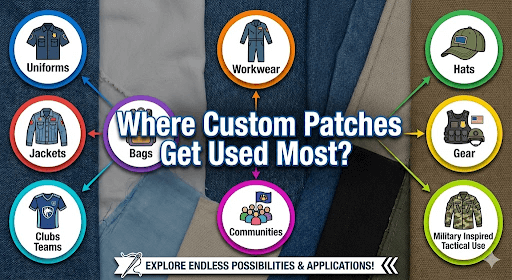
Custom patches are a system. Here are the highest impact uses where patches consistently pay off.
Uniforms And Workwear
- Name and role patches for faster communication
- Logo patches for brand consistency
- Department or safety patches for clarity
This is where custom sew on patches shine for durability and high wash cycles.
Hats Jackets Bags And Gear
- Custom logo patches on hats sell because hats are worn daily
- Jackets and hoodies become walking brand assets
- Bags and backpacks carry patches everywhere
This is where you will see demand for custom leather patches, custom PVC patches, and hook and loop patches.
Clubs Teams And Communities
- Sports teams, scouts, motorcycle clubs, gyms, and hobby groups
- Patch sets that show milestones, membership, or events
This is why custom biker patches for jackets and team patches are always in demand.
Military Inspired Tactical Use
- Unit style identity patches
- Morale style designs
- Hook and loop backings for quick swaps
If you are ordering custom military patches USA, backing choice and durability matter more than looks alone.
Custom Patch Types Breakdown
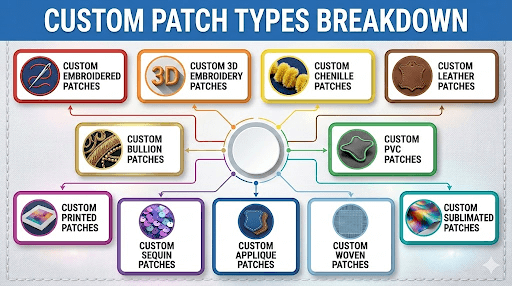
Now, let’s have our gaze on major patch types you will see when you talk to a patch manufacturer. If you want the best patch maker in the USA, you want someone who can explain these options clearly and recommend what fits your use case.
Custom Embroidered Patches
Best for: classic logo patches, uniforms, hats, jackets, clubs
Look: raised thread texture, traditional premium feel
Why people choose it: it looks established and “official”
Good match for:
- corporate uniforms
- service teams
- retail staff
- sports teams
- general merch
Watch outs:
- very tiny text can lose clarity
- complex gradients are not ideal in embroidery
Custom 3D Embroidery Patches
Best for: bold logos, hats, streetwear drops
Look: foam raised embroidery that pops off the patch
Good match for:
- hat front panels
- brand logos with simple shapes
- designs that need depth
Watch outs:
- not ideal for tiny details
- best when the design is simplified and bold
Custom Chenille Patches
Best for: letterman jackets, varsity style, large letters, premium merch
Look: fuzzy, plush, high visibility texture
Good match for:
- varsity jackets
- college clubs
- premium membership merch
- gym achievement patches
Watch outs:
- not for tiny details
- larger designs work best
Custom Leather Patches
Best for: premium hats, denim, jackets, lifestyle brands
Look: clean, high end, minimal, textured
Good match for:
- hat patches
- denim jackets
- workwear brands
- boutique merch
Watch outs:
- thin line art may not show as clearly depending on embossing method
- leather needs the right application method to last on high flex areas
Custom PVC Patches
Best for: outdoor gear, backpacks, tactical, high abrasion use
Look: molded rubber style, clean edges, weather resistant
Good match for:
- outdoor brands
- security and event teams
- bags and backpacks
- gym bags
- tactical style gear
Watch outs:
- can feel heavier than fabric patches
- not everyone wants the rubber look for fashion basics
Custom Sublimated Patches
Best for: full color artwork, gradients, photo like prints
Look: ink fused into fabric, smooth, vibrant
Good match for:
- artwork heavy brands
- complex color designs
- event patches with detailed illustration
Watch outs:
- texture is flatter than embroidery
- premium feel depends on finishing and border choices
Custom Woven Patches
Best for: small text, fine details, clean logos
Look: tight weave, crisp lines, smooth finish
Good match for:
- name patches
- detailed logos
- minimalist design that needs clarity
Watch outs:
- less “raised” texture than embroidery
- works best when you prioritize readability
Custom Applique Patches
Best for: layered fabric looks, bold shapes, sporty designs
Look: fabric pieces stitched together
Good match for:
- bold letters
- large shapes on jackets
- premium layered aesthetic
Watch outs:
- requires smart design planning
- not meant for highly detailed graphics
Custom Sequin Patches
Best for: fashion, dance teams, statement merch
Look: reflective sparkle, high attention
Good match for:
- stage wear
- glam fashion
- limited edition merch drops
Watch outs:
- not ideal for rough daily workwear
- can snag if used on high friction areas
Custom Printed Patches
Best for: sharp full color designs, modern merch
Look: printed surface with clean detail
Good match for:
- art heavy patches
- small runs and fast promos
Watch outs:
- durability depends on production quality and finishing
- may not feel as premium as embroidery unless executed well
Custom Bullion Patches
Best for: luxury, ceremonial, premium clubs and awards
Look: metallic thread, rich texture, high end finish
Good match for:
- golf clubs
- high end uniforms
- awards and commemorative patches
Watch outs:
- higher cost
- longer production time often
- best for premium positioning
How To Choose The Right Patch Type
If you are stuck, use this decision logic. It is simple and it prevents expensive mistakes.
Choose based on where it will be used
- Heavy washing uniforms: embroidered or woven, sew on backing
- Outdoor gear: PVC, hook and loop backing
- Premium hats: leather or 3D embroidery
- High detail logos: woven or printed or sublimated
- Varsity and big letters: chenille or applique
Choose based on your brand vibe
- Classic and established: embroidered
- Tactical and rugged: PVC
- Minimal premium: leather
- Streetwear bold: 3D embroidery, chenille
- Art heavy: printed or sublimated
Choose based on readability needs
If people must read text quickly, woven often beats embroidery for small letters. If the patch is mostly symbol and shape, embroidery and 3D embroidery win.
Backings And Attachment Methods
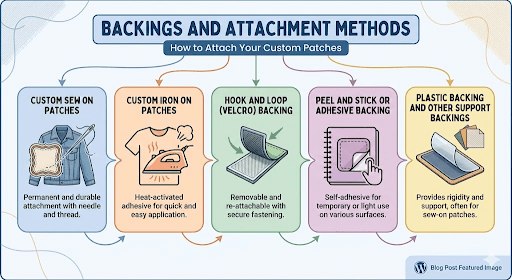
Patch type is the look. Backing is the performance. If you mess up the backing choice, the patch can look great and still fail in real life.
Below are the main backing options and what they are best for.
Custom Sew On Patches
Best for: uniforms, workwear, jackets, items washed often
Why it wins: strongest long term hold
How it’s applied: stitched onto the garment
Best use cases:
- bulk custom patches for uniforms
- heavy duty work shirts
- denim jackets
- bags that take abuse
Watch outs:
- takes time to apply unless you have sewing support
- not ideal for quick temporary campaigns
Custom Iron On Patches
Best for: easy at home application, merch, light to medium wear
Why it wins: fastest for consumers
How it’s applied: heat press or iron activates adhesive
Best use cases:
- customer merch packs
- casual jackets and hoodies
- patches for jeans and casual wear
Watch outs:
- not all fabrics handle heat well
- hats and curved surfaces need extra care
- heavy wash cycles can lift edges over time
Pro move: For high wear items, use iron on to position, then stitch the border. That gives you speed plus durability.
Hook And Loop (Velcro) Backing
Best for: tactical gear, backpacks, vests, swapping roles, rotating identifiers
Why it wins: removable and reusable
How it’s applied: patch has hook backing, garment has loop panel
Best use cases:
- training teams
- event staff roles that change
- morale style patch boards
- backpacks and vests
Watch outs:
- requires a loop panel on the garment or gear
- loop panels collect lint, needs occasional cleaning
Peel And Stick Or Adhesive Backing
Best for: temporary placement, testing layout
Why it wins: quick and no tools
Reality check: not a long term solution for most use cases
Good use cases:
- mockups
- temporary event use
- positioning before sewing
Watch outs:
- adhesive can fail with heat, sweat, friction
- residue can be messy on some fabrics
Plastic Backing And Other Support Backings
These are often used to add stiffness or shape, especially for patches that need structure. Your patch manufacturer will recommend these based on patch type.
Backing Selection Cheat Sheet
If you want a quick answer, here it is.
If it is a uniform that gets washed weekly
Choose sew on.
If it is merch and your customer will apply it at home
Choose iron on, and recommend stitching for heavy use.
If it is gear and you want swappable identity
Choose hook and loop.
If it is temporary or a test run
Peel and stick, but do not expect long life.
Borders And Edge Finishes
Borders are not decoration. They control durability, shape, and how “finished” a patch looks.
Merrowed border
Merrowed borders are the classic stitched edge that wraps around the patch.
Best for:
- simple shapes like circles, rectangles, shields
- embroidered patches with bold outlines
- patches that will be handled a lot
Watch outs:
- not ideal for tiny sharp angles or complex shapes
- can make very small patches look bulky
Heat cut border
Heat cut borders are clean-cut edges, often used for woven and printed patches.
Best for:
- patches with small text
- detailed shapes
- modern clean designs
Watch outs:
- needs solid production quality to avoid fraying
- can feel less “thick” than merrowed borders
Laser cut border
Laser cut is the go-to for complex custom shapes, especially when you want a crisp outline.
Best for:
- custom silhouettes
- unique brand shapes
- layered looks
Watch outs:
- depends on the patch material and finish
- some fabrics need extra backing support for long-term durability
Embroidered border
An embroidered border is a stitched outline that frames the patch and helps the design pop.
Best for:
- premium logo patches
- patches that need a clean outline
- complex shapes that still need a “finished” look
Quick rule: If your patch shape is simple, merrowed is safe. If your design has fine detail or a custom silhouette, heat cut or laser cut is usually better.
Sizing That Prevents Patch Regret
Sizing is where most people mess up. The patch itself can be perfect, but if the size is wrong, placement looks goofy.
The 3 sizing rules
- Measure the placement area first, not your logo first
- Design for readability, not maximum detail
- Avoid “almost fits” sizes that push into seams and curves
Common sizes that work
- Hats: 2.25 to 3.5 inches wide depending on crown style
- Left chest logo on shirts: 3 to 4 inches wide
- Sleeve patches: 2.5 to 3.5 inches wide
- Jacket front patches: 3.5 to 5 inches wide
- Back patches: 8 to 12 inches wide depending on jacket size
One smart trick
Create two sizes for the same design:
- Small for hats and chest
- Medium for jackets and bags
This keeps your branding consistent across products without forcing one size to fit everything.
Patch Placement Guides
Placement is about function, visibility, and brand consistency across teams.
Uniform shirts and workwear
Best placements:
- Left chest logo
- Right chest name patch
- Sleeve role or department patch
Why it works:
- customers and teammates can identify quickly
- the uniform looks balanced
- patch does not interfere with movement
Jackets and outerwear
Best placements:
- Chest logo
- Sleeve patch for role or location
- Back patch for statement branding or team identity
Tip: Back patches sell in merch because they look premium and feel like a real “club” item, especially for custom biker patches for jackets style branding.
Hats
Best placements:
- Front center (most common)
- Side panel (clean for secondary marks)
- Back strap area (subtle branding)
Hats are where leather patches and 3D embroidery patches shine because they read premium immediately.
Bags and backpacks
Best placements:
- Front panel
- Strap area for small ID patch
- Velcro panel area if you want swappable hook and loop patches
If you are doing tactical or outdoor gear, hook and loop patches are a strong move because customers can rotate patches without changing the bag.
Events and festivals
Use patches like wearable tickets:
- staff identifier patches
- VIP patches
- access level patches
- commemorative patches for attendees
This supports brand marketing and turns an event into a collectible moment.
Pricing How Custom Patches Are Costed
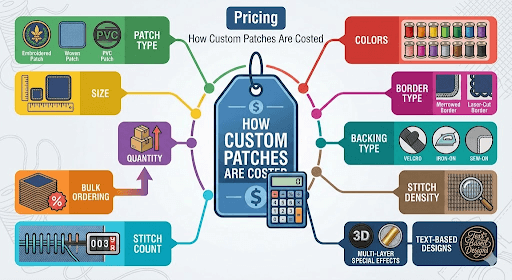
People ask “how much do custom patches cost” and the real answer is “it depends.” But you can estimate cost quickly if you understand what drives pricing.
The main pricing factors
- Patch type (embroidered vs PVC vs chenille vs woven)
- Size (bigger costs more)
- Quantity (bulk lowers unit price)
- Stitch count or complexity (more detail costs more)
- Number of colors (more colors often increases cost)
- Border type (complex borders can cost more)
- Backing type (hook and loop can add cost)
- Special effects (3D foam, metallic thread, sequins, bullion)
What usually costs the most
- Bullion patches
- Complex chenille with layered details
- Large patches with high stitch density
- Multi-layer special effects
What is typically cost efficient
- Standard embroidered patches with a simple merrowed border
- Woven patches for text-based designs
- PVC patches in moderate sizes with clean shapes
Bulk pricing logic
If you are ordering bulk custom patches for uniforms or merch, unit price drops as quantity increases. This is why companies doing multi-location uniforms usually order in batches rather than small repeated orders.
Lead Time What To Expect In 2026
Lead time depends on patch type, quantity, and how fast you approve proofing.
Typical workflow
- Send design or idea
- Get digital proof or mockup
- Approve colors, size, border, backing
- Production
- Shipping
What affects lead time
- Complexity of design
- Custom material sourcing
- Special effects like bullion or chenille layering
- Large order quantity
- Rush production requests
If you need speed, look for:
- fast turnaround options
- clear proofing process
- responsive support
That is what separates a random supplier from a reliable patch manufacturer.
Ordering Checklist For Businesses And Brands
If you want the best place to order custom patches, use this checklist. It prevents expensive reorders and design mistakes.
Specs to finalize
- Patch type
- Size in inches
- Colors (thread or Pantone references if needed)
- Border type
- Backing type
- Quantity
- Placement use case (uniform, hat, jacket, bag)
Design prep that saves time
- Provide a clean logo file if possible
- Keep text readable and not too small
- Simplify tiny details for embroidery
- If you want gradients or photos, choose printed or sublimated
Quality questions to ask any supplier
- Can you share a proof before production
- What is your revision process
- What is the typical lead time
- Do you support bulk reorder consistency
If you are looking for USA#1 Custom Patch Manufacturer style reliability, consistency matters more than buzzwords. You want a supplier who can reproduce the same patch six months later and it still matches your first run.
FAQs
[faq_accordion]
Wrapping Up
Custom patches are simple, but the decisions behind them matter. If you choose the right patch type, the right backing, the right border, and the right size, you get a product that looks premium and lasts.
This is why patches work for uniforms, merch, teams, and brands. They turn plain gear into identity and they do it in a way people actually wear.
When you are ready to order, treat it like a system. Standardize your specs, plan your placements, and work with a trusted patch maker who can deliver consistent quality at scale. That is how you get custom patches that do not just look good on day one, but still look good after real life hits them.